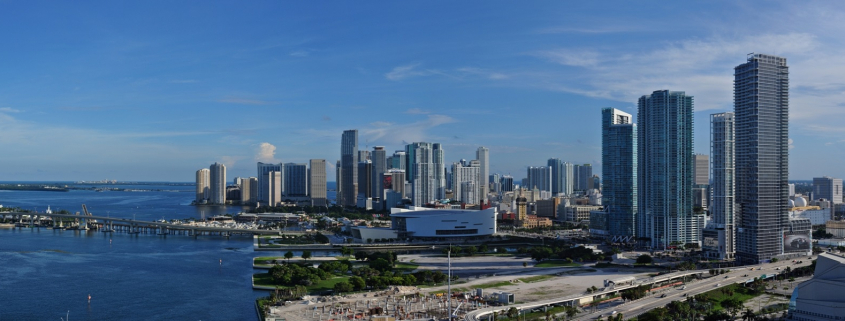
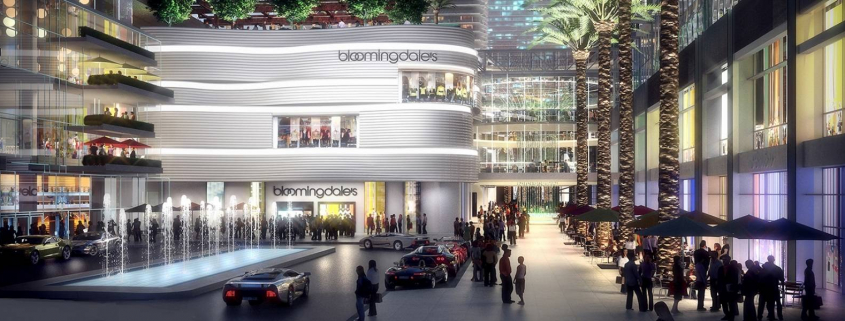
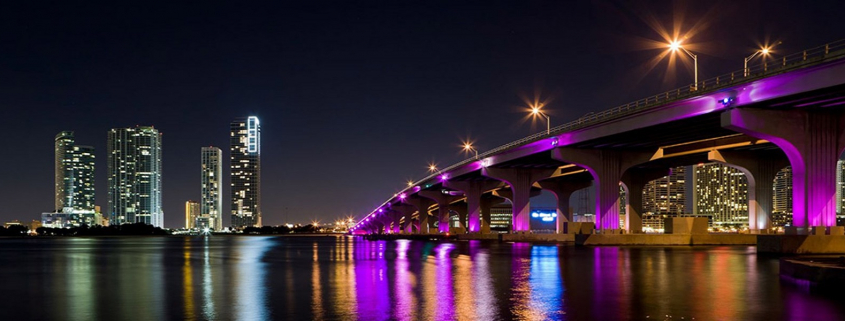
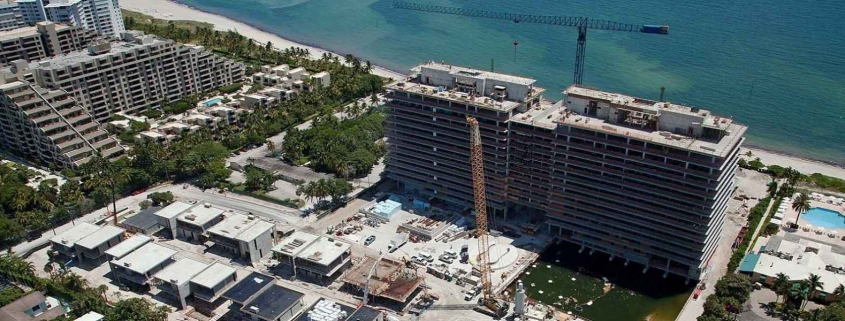
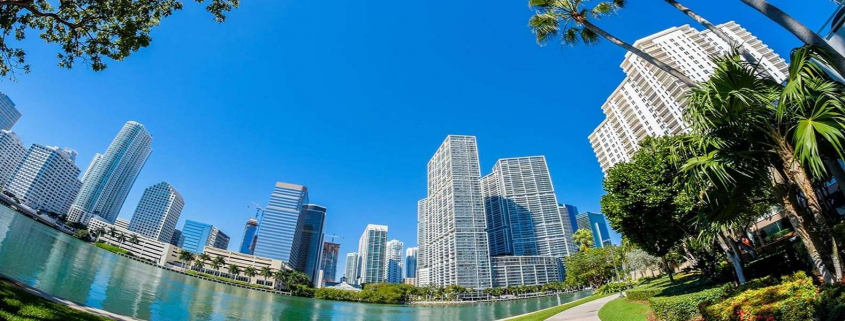
The commercial real estate market outlook for Miami-Dade: Sunny, as long as more mass transit is on the horizon, said industry experts at the Building Owners and Managers Association of Miami-Dade’s 2017 Commercial Real Estate Outlook event.

In the office market, rents are at an all-time high in certain sub-markets, said Brian Gale, Cushman & Wakefield’s vice chairman of Brokerage Services who represents nearly 5 million square feet of office space in South Florida.

On Brickell, office space is hitting around $60 a square foot for Class A space; back in 2008 the high was in the upper $40s, said Gale, during the panel discussion at the East Miami in Brickell. Downtown Miami is just behind it, and Aventura and Airport West have also hit all-time highs, too, he said. Coral Gables presents a different story, he said. In 2007-08, rent in the trophy buildings was $46-$48 a square foot; today it’s the low $40s.

“For many years, Coral Gables was the darling of the office market. I would say it has a temporary black eye with less demand and blocks of spaces still existing. But Coral Gables also has the most to gain,” Gale said.

Gale sees the South Miami market as vaulting too, once new mass transit options fully kick in for the area.

“The traffic on Useless 1 is not getting any better. … Miami Beach needs to figure out a way to get light rail over there.” Gale said. “Rental rates will continue to increase in 2017. Looking further out, being a gateway city … there is no reason to believe we couldn’t be a $70 rental market in 2022.”

Growth in shared office spaces has exploded — for instance, WeWork recently leased 65,000 feet at Brickell City Centre and there are now more than 20 shared workspace centers in downtown Miami alone. Sometimes these shared office centers can act as an incubator for a building; when the companies grow out of the co-working space they take space on other floors, Gale said. In the broader office market, expect more smaller offices, with more open spaces and cubicle areas on the outside of the floor with the glass-walled offices in the center, he added.

In the industrial sector, with job growth projected to slow in 2017 and 2018, is that a concern with 1.8 million square feet coming online in 2017 and 1.4 million in 2018?

“That’s actually less than half of what we have seen in 2015 and 2016.” said JLL Managing Director Brian Smith, who led the team representing NBC Universal/Telemundo Enterprises in the record breaking lease of over 550,000 square feet for a world headquarters broadcast center in western Miami-Dade.

He said he looks more closely at population growth. In both the office and industrial markets, new-to-market tenants are pushing the records. The last three years have brought more than 700,000 square feet of new-to-market office tenants. But that’s more than the previous 15 years combined, Gale said.

The last two years saw 300,00 square feet of new-to-market industrial tenants, but this year it will be 2 million and perhaps 3 million square feet.

“John Deere, new names. We have quickly become one of the most important industrial markets on the globe,” said Smith. “Three large deals in the works may be the biggest ever, in addition to the NBCUniversal deal.”

To be sure, urbanization has transformed the retail landscape, with Miami’s downtown population now approaching 90,0000 people, a 30 percent increase since 2010, with an incredibly affluent demographic, said David Moret, president of Highline Real Estate Capital, which acquires and redevelops office and retail properties with capital partners.

Retail rents are in the stratosphere on Lincoln Road, surpassing $300 a square foot. They are hitting $200 in the Design District and Coconut Grove and Wynwood are flirting with $100 a foot, Moret said. How far will they go?

“I think we have gotten ahead of ourselves,” Moret said. “ I think there will be a reset. … We are already seeing resistance. We are seeing leasing volume way down on Lincoln Road.”

He sees the biggest impact coming from millennials, a group that will have the most spending power by 2017. This means tenant mix is more important than ever.

“Successful centers are going to be about creating experiences, to give people a reason to go there instead of click on their phone,” said Moret.


Source: Miami Herald

About 2.3 million square feet of retail space is set to deliver in Miami by 2018. What will a massive influx of retail supply mean for the overall market?

Jason Shapiro, managing director at Aztec Group, has some opinions. First, he tells GlobeSt.com, it’s noteworthy that the vast majority of that space—approximately 1.4 million square feet—is located within Brickell and Downtown Miami with major mixed-use projects such as Brickell City Centre, Miami Worldcenter and Met Square fueling this new development. That’s according to a Miami Downtown Development Authority.

“While the delivery of over 2 million square feet of retail space by 2018 may sound like a huge number, it is not necessarily an oversupply,” Shapiro says. “Historically speaking, the Miami’s Central Business District has been underserved in terms of access to high quality, international retail brands.”

As Shapiro sees it, substantial residential growth in the Downtown Miami area, along with organic employment growth and increased visitation, have all contributed to improved retail fundamentals. The DDA report found that over 30% of tourists to Miami in 2014 visited the downtown area. That’s a record-breaking number.

“As our city’s demographics evolve and neighborhoods such as Downtown Miami and Wynwood continue to build up and grow more sophisticated, the stronger market fundamentals support the fact that the additional supply will meet demand,” Shapiro says. “Most of the new product coming down the pipeline is luxury, high-street retail that will serve new demographics that live and work in those key urban areas.”


Source: GlobeSt.

A new study by commercial real estate firm CBRE says that rents in Miami are among the most expensive in the world.

Miami’s average monthly rent of $1,868 places it tenth out of 35 global cities studied. Rents in Miami are also increasing quickly, with the seventh fastest rate of growth worldwide last year.

Overall, investors in Miami are said to be earning an overall yield of 2.6$ – second highest in the world.

toptencities-highestrent


CLICK HERE TO DOWNLOAD THE CBRE GLOBAL LIVING 2016 REPORT


Source: The Next Miami

Costs could start to fall for Florida consumers who want to finance energy efficiency improvements with no money down and no credit check.

That’s the optimistic view from Paul Handerhan, a principal of the new Fort Lauderdale-based company, Clean PACE Inc., created to promote and certify program providers in the Property Assessed Clean Energy program.

Over the summer, four providers reached agreements with Broward County to offer property owners countywide the opportunity to finance a wide variety of energy efficiency and storm hardening improvements. Palm Beach County is working out details and expects to finalize agreements by early 2017, Handerhan said.

“Having them compete against each other, ultimately we’re going to see better consumer protections, interest rates and contractor controls,” Handerhan said. “We’re seeing that now. PACE providers are starting to get somewhat competitive in their offerings in order to gain market share.”

Unlike traditional loans, repayment is set up as an assessment on the owner’s property tax bill, and the loan can be transferred to a new owner when the property is sold. Homeowners with mortgage loans can have the repayments rolled into their monthly mortgage bills.

Eligible projects include solar energy systems, new roofs, new hot water heaters, new air conditioning units, upgraded insulation and impact-resistant windows and doors. Customers see cost savings right away as utility bills and homeowner insurance bills fall, supporters say.

Renew Financial, approved on June 14 to offer PACE financing programs countywide in Broward, officially launched its program in Florida.

Cisco DeVries, the company’s CEO, said his business recently certified 150 Florida contractors for PACE programs and is ready to market the program to homeowners throughout Broward and many cities in Palm Beach and other counties.

“Already, the company has hundreds of thousands of dollars in approved contracts with Florida homeowners, many of whom can’t afford upfront costs for expensive improvements,” DeVries said, adding, “We help them knock down those barriers. Formed in 2008 in California, the company completed more than $300 million in residential PACE projects in the state over the past two years. It’s growing very quickly. We signed contracts for more than $49 million in projects in August.”

Interest rates for financing through Renew Financial range from mid-6 percent to low 8 percent, depending on the size and term of the financing, among other factors.

“Assuming interest rates remain low overall in the financial world, consumers could see competition driving rates lower,” DeVries said. Competition is good for consumers and good for cities and counties they serve. Our approach is to encourage multiple PACE providers in cities so everyone benefits. But it’s critical for the programs to have strong rules — clear disclosures to consumers and protections for everyone involved so this continues to evolve.”

The other PACE providers approved to compete countywide are Ygrene Energy Fund, which pioneered the concept in the South Florida market over the past year; Renovate America; and Florida PACE Funding Agency.

Handerhan predicted the PACE market could see some companies offering interest rates as low as 5.9 percent regardless of the loan term. Also, some might seek an edge by lowering origination fees, which tend to be slightly higher than traditional financing.

“Those higher fees come with benefits borrowers don’t get from traditional financing,” Handerhan said. “If I go to a bank and borrow $10,000, I’m kind of on my own at that point. If the contractor walks away, I owe that $10,000 regardless. With PACE, the provider manages every step of the process, including pulling permits and certifying the contractor. The customer only signs off at the end of the process.”


Source: SunSentinel

Primary-election voters approved the expansion of a renewable-energy tax break that backers say will help businesses and spark the expanded use of solar energy in Florida.

But while the measure had support from an array of groups, they are divided on an unrelated solar amendment on the November general-election ballot that could lead to a major political fight.

The proposed constitutional amendment approved Tuesday was known as Amendment 4 and was placed on the ballot by the Legislature. It is designed to extend a residential renewable-energy tax break to commercial and industrial properties.

Shortly after the polls closed, the measure was more than 10 percentage points above the required 60 percent threshold needed for approval of constitutional amendments. The preliminary results indicated that the measure, which backers say will spur growth in solar and renewable energy, was supported in almost every county.

“The strong showing of support for Amendment 4 sends a clear message to elected officials at all levels of government that Florida voters want more diversity in our energy market,” said Sen. Jeff Brandes, a St. Petersburg Republican who sponsored the proposal during the 2016 legislative session.

Though approved by voters, the measure still needs the Legislature to enact the changes. The measure, sponsored in the House by Rep. Ray Rodrigues, R-Estero, and Rep. Lori Berman, D-Lantana, will exempt for 20 years the assessed value of solar and renewable-energy devices installed on businesses and industrial properties.

“Eliminating high tax barriers will unleash the potential of the ‘Sunshine State’ to become a leader in solar energy production,” Rodrigues said in a statement.

“The election results allow Florida to enter a new era where renewable energy can be accessible for all, and clean energy jobs can be at the forefront of Florida’s economy,” Berman said.

Voters approved a similar exemption for residential property owners in 2008, with the measure taking effect in 2014.

The new proposal also has an element to help residential property owners, as it would exempt all renewable-energy equipment from state tangible personal property taxes.

Support for the measure came from a wide range of organizations such as the Florida Retail Federation, the Florida Restaurant & Lodging Association, the Florida Petroleum Marketers and Convenience Store Association, the Florida AFL-CIO, the Nature Conservancy, the Sierra Club of Florida and Surfrider Foundation.

A poll released last week by the Florida Chamber of Commerce showed 70 percent of Floridians supported the proposal, with 14 percent opposed. Yet on Friday Mason-Dixon Polling & Research released findings that indicated the measure was having serious trouble with Republicans and independent voters.

Some late opposition to the measure came from groups such as the Orlando-based political action committees Stop Playing Favorites and the Advocacy, Action & Accountability Alliance, which claimed the amendment would provide “millions in tax breaks to big corporations” at the expense of money that would otherwise flow into minority communities.

Backers of the measure also had to overcome some confusion that the proposal was linked to a separate utility-backed solar proposal on the November ballot.

With Tuesday’s victory, supporters of Amendment 4 are now expected to divide up on what is known as Amendment 1 in November.

Stephen Smith, executive director of the Southern Alliance for Clean Energy, said his group is ready to immediately “pivot” from having supported Amendment 4 to vocally opposing Amendment 1.

“What Amendment 1 does not have is the support of a broad, very diverse, grassroots coalition,” Smith said. “It is exactly what it is, a utility-backed, utility-funded, self-promoting approach to try to keep a monopoly control on their terms.”

The November “Consumers for Smart Solar” initiative would generally maintain the status quo in allowing Floridians with solar equipment on their property to sell energy to power companies.

More than $15 million has already been spent promoting the November amendment.


Source: Daily Business Review

Related Group and The Allen Morris Company are proposing a $250 million project to replace city-owned parking garages at 245 and 345 Andalusia Avenue in Coral Gables.

The project, called Coral Gables City Center, would have two 16-story towers and could be built in phases.

TOWER 1:

  • 140,000 square feet of office space
  • 11,871 square feet of ground-floor retail
  • 770 parking spaces

TOWER 2:

  • 270 residential units (either rental or condo)
  • 16,878 square feet of ground-floor retail
  • 799 parking spaces

Zyscovich is the architect. Related and Allen Morris are competing against another bid from ZOM and Terranova. Both were the finalists selected out of five bidders for the property, and the city commission will vote later this month.


Source: The Next Miami

MiamiApartmentConstruction_5

Miami’s apartment scene is booming, with the market projected to deliver 13,245 new units in 2016, per Rent Cafe.

This ranks eighth nationally, closely behind Austin (13,568) and Seattle (13,384).

Texas paves the way, with Houston topping the list at nearly 26,000, followed by Dallas (23,159).

Midtown has been especially hot with rental projects, with several new developments announced within the past few months.

Top20MetrosApartmentDeliveries


Source: Curbed Miami

Slower sales and a glut of inventory has led to a buyers’ market for South Florida luxury properties, according to Miami Beach real estate agent Jill Eber.

“For almost five years we were just on an upward spiral,” Eber, of Coldwell Banker’s the Jills, told a gathering of real estate professionals Wednesday evening. “But, right now, it has adjusted and it has become more of a buyers’ market. As a result, developers are adjusting their pricing and increasing broker commissions to move units. In no way is this like 2008, 2009, and 2010. The market has been steady.”

Eber participated on a panel hosted by the Miami chapter of the Asian Real Estate Association of America at Brickell City Centre’s East, Miami hotel. The discussion was moderated by Coldwell Banker luxury real estate Vice President Craig Hogan and featured Debora Overholt, Brickell City Centre’s vice-president for retail, Swire Properties Vice President Maile Aguila, Eber, Miami Association of Realtors President Teresa Kinney and Ramona Messore, vice-president of Saks Fifth Avenue at Brickell City Centre.

Overholt and Aguila offered their insights into Swire’s ability to finish massive developments like Brickell City Centre. Overholt noted that the $1 billion nine-acre mixed use project is modeled after Pacific Place, a complex of office towers, hotels and a shopping centre the company built in Hong Kong 27 years ago.

“If you are familiar with Pacific Place, what we are developing is very similar to that,” Overholt said. “We are very excited to bring something fairly new to U.S. retailers, but something we already do well.”

Since opening in 1989, the four-floor mall at Pacific Place has more than 711,000-square-feet of retail space that houses a Harvey Nichols department store and 140 luxury brand shops and boutiques. Similar to Brickell City Centre, the mall is integrated into three Class A office towers, four five-star hotels, and a condominium. Swire spent $2.1 billion in 2011 on a redesign project led by Thomas Heatherwick.

Aguila told the audience Swire’s success with Pacific Place proves the company has the strength and wherewithal to deliver every phase of Brickell City Centre.

“When we do things, we do things long-range and take a long time,” Aguila said. “I remember when we were developing Brickell Key, we were all looking forward to a retail component and food and beverage component that just never happened. We saw that need. We had the vision to come into the area at the right time and the right place.”


Source: The Real Deal

An entrepreneur who’s bought a big chunk of downtown Miami while promising some mold-breaking surprises was apparently not kidding: He wants to build an eye-catching 49-story tower with apartments so small there’s no room for ovens in the tiny kitchens. And there’s no parking.

Actually, that last bit’s not quite right. There will be parking — for bicycles. Is Miami really ready for this?

Moving-company and arts mogul Moishe Mana — who’s also building a mini-city on a large swath of Wynwood and has lately spent tens of millions to buy up property on and around downtown’s Flagler Street — certainly thinks so.

A rendering of developer Moishe Mana’s proposed “micro-living” apartment tower. (Zyscovich Architects)

A rendering of developer Moishe Mana’s proposed “micro-living” apartment tower. (Zyscovich Architects)

He’s the first in Miami to formally propose putting up a building consisting entirely of what’s been dubbed “micro-units” — compact, hyper-efficient and affordable apartments meant for young singles who want to live in dense urban neighborhoods and get around primarily on foot and public transit. The plan, which Mana’s team says fully conforms with downtown zoning rules, will have its first and likely only public review before the city’s Urban Design Review Board on Monday

MicroApartments3The blueprint calls for 328 apartments starting at 400 square feet, the minimum allowed by city code. The penthouse units top out at a relatively generous 600 square feet, but most will be 500 square feet and under, said the project’s architect, Bernard Zyscovich.

The apartments would be equipped with built-in furnishings, including beds and tables, that tilt, fold or slide into walls and cabinets, Zyscovich said. And the building, at 200 North Miami Ave., would be flush with amenities, including built-in superfast WiFi and fully equipped common kitchens and dining rooms for when residents want to entertain.

“It’s like living in a Transformer,” Zyscovich said. “The idea was, let’s make these apartments in the urban core, let’s make them small and let’s build in all the stuff that makes it desirable. We’re going for that authentic coolness that comes from being in the middle of everything. It’s for a particular type of person, probably Millenials but not exclusively so, who want to live an urban life and simplify their life, and not have all their money going to rent and furniture and maintaining a car.”

Rents, which have not been set, would be at market rates, but would be significantly lower than the norm downtown and in surrounding neighborhoods like Brickell — where high costs have some renters taking in roommates and doubling up in bedrooms — by virtue of the apartments’ small size. The substantial savings Mana will realize by not having to build costly structured parking will also help keep rents down, Zyscovich said.

A rendering of developer Moishe Mana’s proposed “micro-living” apartment tower. (Zyscovich Architects)

A rendering of developer Moishe Mana’s proposed “micro-living” apartment tower. (Zyscovich Architects)

The project takes advantage of a zoning exemption that allows buildings close to transit stations in downtown Miami to dispense with parking. The building, on a sliver of land that Zyscovich said would make it hard to fit in a parking garage in any case, sits a short stroll from the Government Center Metrorail station, three Metromover stops and the station for the All Aboard Florida train service, now under construction.

There is lots to walk to nearby, including courthouses, government buildings and offices with tens of thousands of jobs, not to mention classes at Miami Dade College’s downtown campus two blocks away. The All Aboard station will have a food market, and Whole Foods and Publix stores can be reached by Metromover or city trolley.

Those who insist on having a car have options: The building site abuts a big city parking garage, and another public garage sits a couple of blocks away.

Two South Florida analysts predicted Mana will have no trouble renting out the building at a time where rents in Miami have risen much faster than salaries, creating a housing affordability crisis.

If Mana rents his apartments in the middle of the range for the area, or about $2.25 a square foot, that means someone could get into one of the 400-square-foot units for $900 a month, a relative bargain, while enjoying the privacy of his or her own space, noted Jack McCabe at McCabe Research in Broward County.

“They will fill it up,” McCabe said even as he expressed surprise at the apartments’ size and lack of fully equipped kitchens — though they will have cooktops. “Affordability is key right now. There is definitely demand for more-affordable rentals without a real kitchen in a cramped apartment that allows you to enjoy the lifestyle in downtown Miami.”

McCabe said the common kitchens, which Zyscovich said would have to be booked in advance, are a desirable feature for many people, and the compact units would not bother many of the South Americans and Europeans now flocking to the city who are used to living in smaller spaces than Americans.

The “micro-living” concept, which is catching on in other U.S. cities like Seattle, San Francisco and New York — the Big Apple’s first such building just opened in the Kip’s Bay neighborhood on the east side of Manhattan — can help solve not just the affordability problem but also relieve traffic congestion, said Suzanne Hollander, a broker and lawyer who teaches at Florida International University’s Hollo School of Real Estate.

“It’s very smart. It’s pioneering,” Hollander said. “Micro units are tiny solutions to big urban problems, and Miami is becoming a big urban city. It gives options to a lot of people who otherwise would not have them, so they can enjoy the urban living we are building.”

Micro-living buildings also carry other potential social benefits that could prove attractive not just to Millenials but also to retirees or business executives who need a pied-a-terre, she added.

“People sleep in a micro-unit. But, really, the whole building is their home,” Hollander said. “And the amenities here are amazing. What they’re trading is space for an A-plus location. This all encourages people to interact not just inside the building, but in the neighborhood, making everything more social.”

Another benefit, she said: Because the units are new and built to code, they are safer alternatives to the unregulated rooms in older homes or apartment houses that are often the only alternative for people on limited incomes.

Micro-units in New York and elsewhere are even smaller than Mana’s, with those in New York’s Carmel Place ranging from 260 to 360 square feet after the city waived its 400-square-foot minimum. That’s something some advocates are pushing to happen in Miami as well.

The no-parking alternative has a longer track record in Miami. Other developers have used the transit exemption to build no-parking residential towers downtown, including Related Group’s Loft buildings, but those units are for sale and tend to be larger. Units at Centro Miami, a high-rise condo tower now nearing completion, also without parking, range from 500 to over 1,111 square feet.

A new city zoning rule also allows for small buildings near transit routes to forgo parking. A small developer has broken ground on townhouse-like apartments without parking in East Little Havana.

Though Mana’s apartments will be small, the tower’s design aims to make a big impression, Zyscovich said. It looks like stacked blocks, with some sides on the west and south screened with a “veil” of metal mesh to shade them from the sun.

“It wants to say, I may filled with micro-units, but I’m cool,” the architect said.


Source: Miami Herald

MiamiWorldcenter_6

Miami officials will consider the design plans of five new projects in the booming city, including the redesigned Miami Worldcenter, an apartment tower with no parking by a prominent developer and a mixed-use building in Midtown.

All five items will go before the city’s Urban Design Review Board on July 25.

The 27-acre Miami Worldcenter is a major mixed-use project that would reshape the north side of downtown. Construction has already started on its first phase, although it hasn’t gone vertical yet. The master developer is Miami Worldcenter Associates, led by Art Falcone and Nitin Motwani, with Los Angeles-based CIM Group as an equity partner.

The main public plaza at Miami Worldcenter

The main public plaza at Miami Worldcenter

The new design reflects Miami Worldcenter’s transformation from big-box, enclosed retail to “high street” retail that is integrated with the urban street grid and incorporates public space and art.

Other major projects proposed or under construction in downtown Miami and Brickell can be found on the Business Journal‘s interactive Crane Watch map.

The new Miami Worldcenter design was partially inspired by Dacra’s work in the Miami Design District, as its presentation includes numerous photos from that upscale retail district to the north. Miami Worldcenter would have a long paseo that crosses several streets, capped with public plazas at both ends – similar to the Paseo Ponti/Palm Court Plaza/Paradise Plaza stretch of the Miami Design District.

The Miami Worldcenter paseo would start around Northeast 1st Avenue and stretch from Northeast 7th Street to Northeast 10th Street. It would have a 25,000-square-foot main plaza of public space on the south side and a 14,000-square-foot plaza on the north side. Those plazas could be used for special events and performances, the application said. The public spaces would be lined with trees, water features and art. There would be a vehicle drop off circle at Northeast 2nd Avenue.

Miami Worldcenter was designed by Elkus Manfredi Architects and ADD, with Kimley Horn as the landscape architect. Greenberg Traurig attorney Ryan Bailine represents the developer in the application.

The lot coverage of Miami Worldcenter’s first phase, encompassing about 10 acres, would be reduced from 88 percent to 81.5 percent. The density would decrease.

The first phase would total 3.91 million square feet, down from 4.73 million square feet in the previously-approved design. That reduction would mostly come on the commercial/retail side, with 338,036 square feet planned instead of 1.09 million square feet. Most of the retail would be on the ground floor, with some extending to a second floor. The retail buildings would have parking on the upper floors, and in most cases restaurants or amenities on the rooftops.

The residential unit count in Miami Worldcenter phase one would increase to 1,011, from 914, and the parking spaces would increase to 3,998 from 3,901. The 58-story Paramount Miami Worldcenter condominium could have up to 577 units in 1.34 million square feet, instead of 485 units, and the 44-story Luma apartment tower would have 434 units in 545,762 square feet, instead of 429 units. Luma would be developed in partnership with Orlando-based ZOM.

Paramount would rise atop a podium filled with amenities and it would be connected via an elevated bridge to a parking structure with even more amenities atop it. Luma would also have an amenity deck. The features would include multiple pools, a soccer field, two tennis courts, a half-court basketball room, two racquetball rooms and fitness areas. The condo tower would also have a yacht-shaped amenity deck on its top floor.

The application notes that up to 8.24 million square feet could be developed in the future phases of Miami Worldcenter. The next phases of the project would include a 386-unit apartment tower along Northeast 7th Street, a mixed-use tower in partnership with Newgard Development and the Marriott Marquis Hotel and convention center in partnership with MDM Group. Representatives of Miami Worldcenter couldn’t immediately be reached for comment.

Moishe Mana Proposes Apartments Without Parking

New York developer Moishe Mana wants to build 328 apartments with no parking in downtown Miami.

49-story apartment tower rendering

49-story apartment tower rendering

The 49-story would total 322,355 square feet at 200, 218 and 222 N. Miami Ave. Not counting the amenities and common areas, it would have 277,536 square feet of residential space, so that averages 846 per unit.

Downtown Miami allows developers to forgo parking requirements within close proximity of public transit. This property is near the Government Center Metrorail Station and a public parking garage. That garage is slated to be redeveloped with an apartment building incorporated into it.

Mana’s North Miami Avenue Realty LLC acquired the 14,325-square-foot site in 2014 for $4.2 million. It currently has some small retail buildings constructed from 1922 to 1925. They would be demolished to make way for the apartment tower.

Zyscovich Architects designed Mana’s project, which would feature a rooftop pool deck, a gym, a social room, an exterior courtyard on the 15th floor and micro amenity spaces of around 900 square feet on some residential floors. Mana is one of the largest landowners along Flagler Street in downtown Miami and has proposed a massive redevelopment in the Wynwood neighborhood.

Mixed-Use Project Could Rise In Midtown

Midtown 8 rendering

Midtown 8 rendering

A 28-story building in Midtown Miami would combine residential and retail space. Midtown 8 would total 389,989 square feet on the two-acre site at 2901 and 2951 N.E. 1st Ave. That would break down to 387 apartments, 29,549 square feet of ground-floor retail and 519 parking spaces.

The project would have an amenity deck featuring a pool on top of the eight-story parking garage, which would be connected to the apartment building by a series of elevated bridges. There would be an open-air driveway through the center of the project and a linear park with an art along the FECI rail line behind the building.

The property is owned by Midtown Opportunities VIB, but it’s under contract to developer Wood Partners, with offices in Atlanta and West Palm Beach. Midtown 8 was designed by StantecGreenberg Traurig attorney Ryan Bailine said his client hopes to apply for building permits for Midtown 8 in August or September and obtain them before the end of the year.

Wynwood Attracting Major Projects

Wynwood 26 rendering

Wynwood 26 rendering

The UDRB will also consider two new proposals in Wynwood, which has attracted many development applications after the neighborhood was rezoned. The Wynwood 26 apartment/retail building by the Related Group was previously covered by the Business Journal when the plan went before the Wynwood Design Review Committee.

Wynwood 25 rendering

Wynwood 25 rendering

East End Capital‘s Wywnood 25 with apartments and retail was also considered by the WDRC shortly after it was announced.


For a slideshow for the new renderings of Miami Worldcenter, plus the other projects, that will be presented to the UDRB, click here.


Source: SFBJ