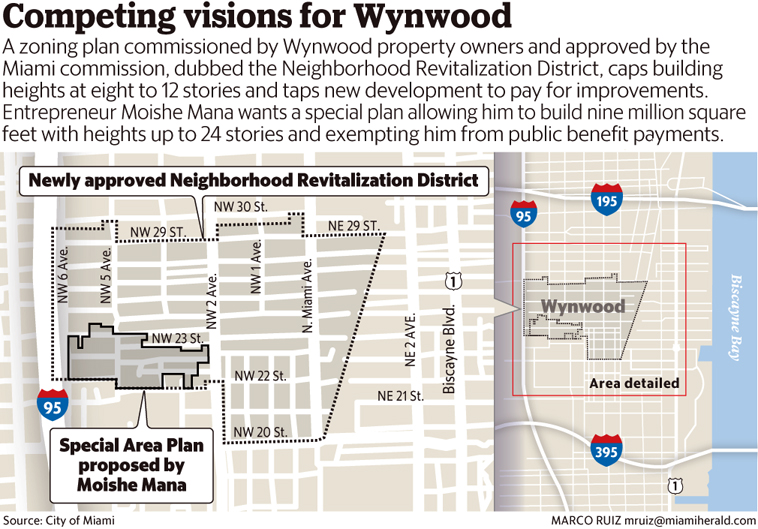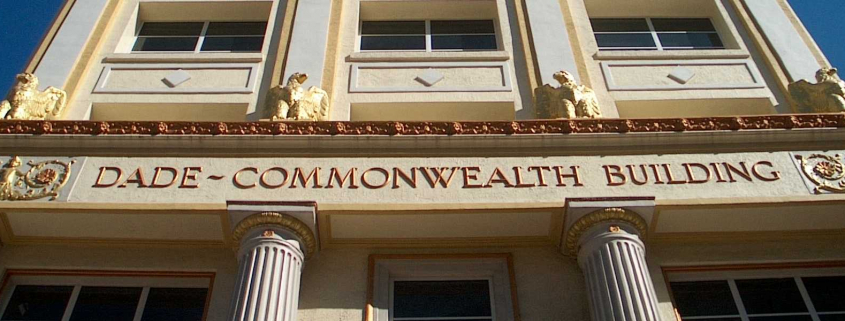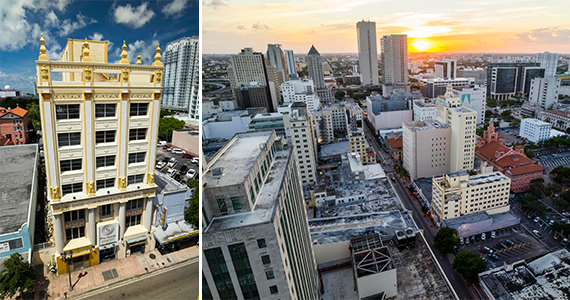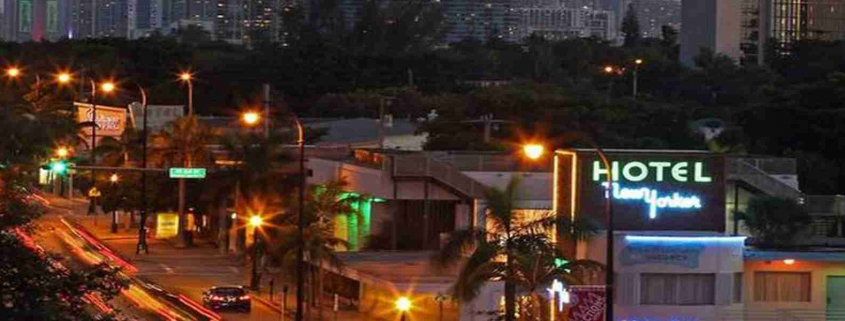
The 90-year-old Dade-Commonwealth Building in downtown Miami sold for $9.2 million to a group that promises to revitalize it.

The seven-story office building at 139 N.E. 1st Street was originally constructed in 1925 to serve as a branch of Meyer-Miser Bank, but it was heavily damaged by the Great Miami Hurricane of 1926. It was reconstructed the following year.

Dade Commonwealth Building2

The building still has a 32-ton magisterial stainless steel vault and its original columns.

A joint venture between Immocorp Capital, led by Gilbert Benhamou, and Wynwood Fund, led by Matthieu Merchadou-Melki, bought the 43,265-square-foot building on a 7,500-square-foot lot from Titan Development Partners, managed by Jesus V. Suarez. It last traded for $1.3 million in 2003.

“We intend to revitalize this corner in the heart of Downtown Miami,” said Benhamou. “This is an iconic building that, once upon a time, was the tallest building in Downtown Miami. We were seduced with the historical aspect and story of the Dade-Commonwealth Building.”

The buyers were represented by Urbanize PropertiesJanet Crucet and Kristine Flook plus Sterling Commercial’s Mika Mattingly. Ana Ventura of RE2000 Group represented the seller.


Source: SFBJ

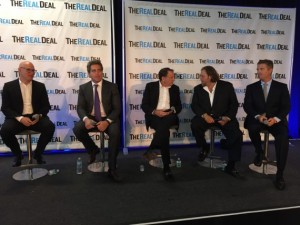
A panel of major Miami developers, many of them billionaires, gathered at The Real Deal South Florida’s Real Estate Forum & Showcase to talk about their upcoming projects and give their take on when this real estate cycle will come to a close.

Craig Robins, Jeffrey Soffer, Richard LeFrak, Gil Dezer and Michael Simkins

Craig Robins, Jeffrey Soffer, Richard LeFrak, Gil Dezer and Michael Simkins

In attendance was Richard LeFrak of the LeFrak Organization, Jeffrey Soffer of Turnberry Associates, Gil Dezer of Dezer Development, Craig Robins of Dacra and Michael Simkins of the Innovate Development Group.

The five heavyweights touched on themes like what it means to build a neighborhood and the challenges involved with planning a multibillion-dollar project. However, one topic reigned supreme: is South Florida headed for a crash?

“In the long run, what is going to happen is what always happens: the weak will not survive, the strong will survive, and the ones who survive will thrive,” said LeFrak, chairman and CEO of the LeFrak Orgnization.

To watch the panel from start to finish, check out the video below, or go to The Real Deal‘s YouTube page.


Source: The Real Deal

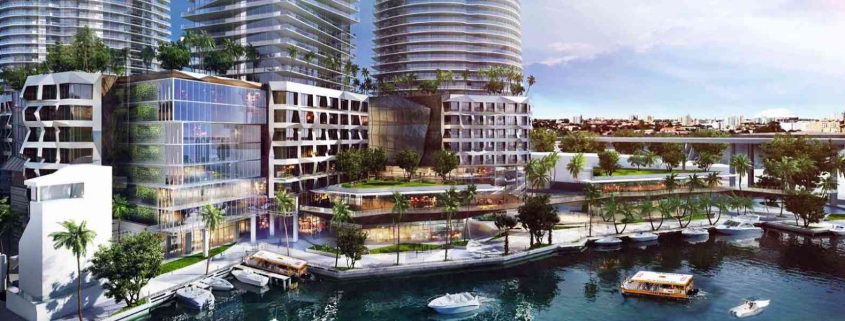
New York-based Chetrit Group and local developer Ari Pearl’s plans for a $1 billion Miami River project have moved a step closer to reality.

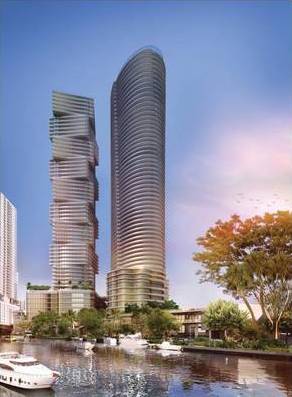
A rendering of the Miami River project

A rendering of the Miami River project

The Miami City Commission late Thursday unanimously approved a development agreement and rezoning of a 10-acre site where Pearl and the Chetrit Group plan to build the mixed-used site that includes four towers, a hotel, shops, restaurants, and a public river walk with boat slips. There, a large section of Little Havana along the Miami River will get a major facelift.

To obtain city approval for higher density, the developers promised to invest $14 million into an affordable workforce housing fund, as well as $7 million for public infrastructure surrounding the project, including renovating nearby Jose Marti Park. Raymond Jungles has designed the plans for the park.

“This project is of city-wide importance,” the developers’ lawyer Melissa Tapanes Llahues told commissioners. “It makes the vision of an interconnected city a reality.”

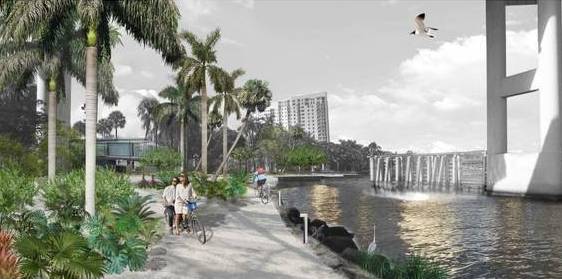
A rendering of the Miami River project

A rendering of the Miami River project

Located between Southwest Second Avenue and Southwest Third Avenue, the Miami River and Southwest Seventh Street, the project will be built in five phases. The complex would have 1,678 residential units, 330 hotel rooms, 266,000 square feet of retail and office space, and more than 2,000 spaces. The first tower with 200 hotel rooms and 328 condos, Tapanes said, is scheduled for by the end of 2018. The developer is also getting 1.2 million square feet of “air rights” from the city at $17.82 a square foot, or $21 million, which is being used for the public improvements.

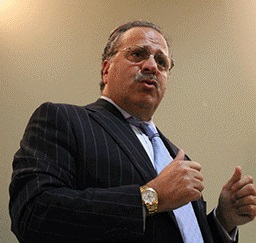
Joseph Chetrit

Joseph Chetrit

Pearl and the Chetrit Group have been working on the project’s design since they assembled the land for roughly $100 million last year. Some of the properties they acquired included the Finnegan’s River restaurant and the Pleasure Emporium adult superstore.

The developers and their architect, Kobi Karp, also consulted with the Miami River Commission on the site’s design which calls for restaurants and shops to line the river walk that will be accessible to Brickell and East Little Havana residents. There will also be a public gathering place at an I-95 underpass.

“This is a very exciting project in a blighted area that could use some enthusiasm,” said Miami River Commission Chairman Horacio Stuart Aguirre.

The commissioners also heard from a dozen residents and property owners who spoke in favor of the project. City Commissioner Frank Carrollo, whose district includes the site, gave the project a thumbs up after negotiating some more concessions from Pearl. Carrollo said the developers had agreed to contribute $14 million to the city’s workforce affordable housing fund and to set aside a space for the city to build a small paramedic station. The first $1 million is due when Pearl and Chetrit submit site plans for the towers, which they expect will be sometime in February 2016. Another $1 million is due once the first building permits are approved.

“This is a beautiful project,” Carrollo said. “I am glad to say I met with the developer and his team to address some issues


Source: The Real Deal

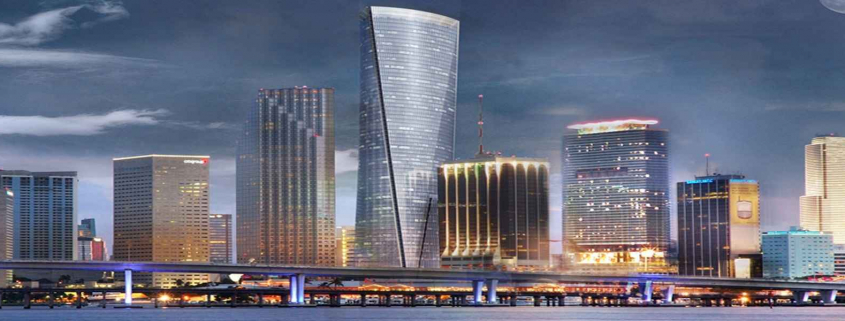
Florida East Coast Realty obtained approval from the Federal Aviation Administration (FAA) for the height of two planned towers in downtown Miami, both designed to rise about 1,000 feet.

The FAA approved the designed height Florida East Coast’s 1,005-foot One Bayfront Plaza and the company’s 995-foot 1201 Brickell development. In a separate decision, the FAA recently approved the designed height of six Miami condo buildings by Related Group, including two taller than 800 feet.

The FAA had issued  preliminary notices of “presumed hazard” to Florida East Coast because the federal agency was concerned that the height of One Bayfront Plaza and 1201 Brickell could interfere with air traffic.

Florida East Coast designed 1201 Brickell as a twin-tower residential development with 787 units. One Bayfront Plaza is planned at a location on the west side of Biscayne Boulevard between Southeast 1 Street and Southeast 2 Street. The $1.4 billion project would include 768,000 square feet of office space. The mixed-use development also would encompass 643 hotel rooms, 97,000 square feet of retail space and 110,000 square feet of meeting and convention space.

The tallest building in Miami now is the Four Seasons hotel at 1435 Brickell Avenue, which is 789 feet tall. Florida East Coast will top that when it finishes its 822-foot Panorama Tower at 1101 Brickell Avenue, now under construction. Swire Properties eventually may have the tallest tower in town: The developer plans to build a 1,049-foot tower in a future phase of its Brickell City Centre development along South Miami Avenue between 8 Street and 6 Street.


Source: The Real Deal

When Avra Jain bought the Vagabond Hotel in Miami’s MiMo district two years ago, she couldn’t capture the interest of traditional real estate investors.

Comparable rates along Biscayne Boulevard were $60 a night — or $20 an hour, she quipped. Now, after redeveloping the property into a boutique hotel with financial backing from friends and family, off-season rates stand at $159 a night, and the coming season will command $229 to $259 per night.

Changes taking place in the commercial real estate market in neighborhoods like MiMo and Wynwood are spurring widespread revitalization in Miami and creating other newly emerging areas, panelists said Friday at the Miami Association of Realtors’ RCA Super Conference, held at the Biltmore Hotel in Coral Gables.

In MiMo, Jain realized that dilapidated motels were hurting the area, so she purchased seven motels along the Biscayne Boulevard strip and shut them down. “And that is when the neighborhood started to change,” she said during a panel, “Emerging Miami: Miami River, Lemon City & Little River.”

Much more change is on the horizon. In a year, the MiMo District “will be lit up with neon and restaurants and will surprise everybody,” she told more than 100 conference attendees. Retail rents are rising rapidly, and now stand at about $50 to $70 per square foot, and $45 for second floor office space, Jain said.

Meanwhile, as Miami’s once gritty Wynwood transforms and rents there rise as well, art galleries, local businesses and creative types are being priced out, and are moving to more affordable and newly emerging — yet historic — areas like Little River and Lemon City, the panelists said. That’s where Thomas Conway’s MADE, a new co-working space for creative entrepreneurs, has recently opened. Creating a sense of place is key, the panelists said.

“We’re basically being the stewards of revitalizing these neighborhoods,” said Tony Cho, founder and CEO of Metro 1.

With investors redeveloping property, Wynwood has quickly become a thriving neighborhood, with a curated collection of new shops, restaurants, bars and breweries that attract a pedestrian crowd at all hours of the night. “It’s remarkable,” Cho said of the transformation. “It has exceeded my original expectations.”

Along with that, commercial rents are now as high as $80 per square foot on Northwest Second Avenue in Wynwood — compared to $10 per square foot 10 years ago, Cho said. In fact, Starbucks and other national retailers are starting to look into the area. That poses a challenge to retaining the neighborhood feel, the panelists said.

“People are fearful that Wynwood will turn into Lincoln Road,” Cho said.

The speed of transformation is accelerating, and with so much commercial activity in Miami, Jain said she does not worry about a downturn similar to what South Florida experienced in the last cycle.

“I don’t think Miami necessarily has to be roller coaster any more,” Jain said, citing commercial markets in Miami that are still underserved and the continuing demand for boutique hotels. “I’m starting to see it differently.”


Source: The Real Deal

A day after Miami-Dade’s cultural affairs director disclosed the county is interested in teaming up with private developers to build high rise towers at the downtown cultural complex that is home to HistoryMiami and the central library, Mayor Carlos Gimenez said there are many more projects that could be open to public-private partnership, or P3s.

“The only way we are going to get any of them done is with P3s,” Gimenez said. “If we have to maintain and operate all these things, we couldn’t do it.”

On Friday, Gimenez participated in a panel discussion about the county’s transportation needs, put on by the P3 Institute at Florida International University’s north campus. A packet prepared by the P3 Insitute listed roughly $7.5 billion in unfounded county projects Miami-Dade officials are considering for possible partnerships with private companies.

Some of the projects include three general maintenance and office facilities that will cost an estimated $120 million to build, a $20 million African Heritage Cultural Arts Center, an expansion and new garage for the Miami-Dade County Auditorium that will cost an estimated $40 million, and four new jail facilities that will cost an estimated $625 million. On Thursday, the county’s cultural affairs director had discussed the future partnership potential of the downtown cultural complex, as reported by the South Florida Business Journal.

Gimenez said the county will also consider public-private partnerships for all future transit projects, including Baylink, a light rail that will connect Miami Beach to Miami via the MacArthur Causeway, and for an east-west transit connection from the airport to Kendall. Gimenez also said he would like to see Baylink’s track expanded in Miami Beach and Miami to include the Julia Tuttle Causeway, so that trains could go through the Design District, Midtown and Mid-Beach.

Neil Sklar, a partner with the law firm Peckar & Abramson and P3 Institute president, told The Real Deal that his organization hosted two-day panels on public-private partnerships to give the county an opportunity to meet with private company executives who are interested in pursuing deals.

“I was surprised to learn the county has many more projects that people don’t know about,” Sklar said.


Source: The Real Deal

It’s no secret that Miami has become one of the world’s most attractive markets for international investors.

South Americans in particular have had a heavy influence in local real estate as one of the main demographics snapping up properties throughout South Florida.

But data from CBRE, a commercial brokerage that tracks such international trends, indicates that one region of the world is poised to take a much larger role in South Florida’s real estate game and in the United States as a whole: the Middle East.

Miami Beach EDITION hotel

Miami Beach EDITION hotel

So far, buyers from the Middle East have stuck to high-profile properties in Miami. This was made evident in February with the Abu Dhabi Investment Authority’s acquisition of the Miami Beach EDITION hotel for an incredible $230 million. That sale accounted for the majority of the $280 million Middle Easterners have sunk into South Florida real estate during the first half of this year, according to CBRE data.

Plot on Indian Creek Island — the highest price ever recorded for vacant land in the neighborhood

Plot on Indian Creek Island — highest price ever recorded for vacant land in the neighborhood

Also in February, a corporate entity linked to Saudi Royalty paid $23 million for a plot on Indian Creek Island — the highest price ever recorded for vacant land in the neighborhood.

St. Regis Bal Harbour hotel

St. Regis Bal Harbour hotel

Compared to last year, buyers from the Middle East have spent $37 million more on Miami real estate, CBRE data shows. The previous year saw Al Faisal Holding, a private company based out of Qatar, pay $213 million for the St. Regis Bal Harbour hotel, among other smaller transactions. However, in the context of the region’s historically large purchases, that increase does not necessarily translate to a large uptick in activity.

The evidence of this emerging trend instead comes from looking at the huge amount of money that the Middle East is pouring into U.S. real estate.

For the first half of 2015, the region spent $2.7 billion on real estate in the Americas, according to CBRE. That’s a significant chunk of the $11.8 billion total that investors from the Middle East have spent on global real estate during that time period, and CBRE expects that number to grow by another $2.4 billion by the end of the year. Most of that money comes from sovereign wealth funds.

“There’s no question that Miami has arrived as a primary market for investors worldwide, in the same league with other U.S. cities like New York, San Francisco and D.C., as this Middle East investment report suggests,” Quinn Eddins, CBRE’s director of research and analysis for Florida, said in a statement.

“The amount of foreign investment in South Florida office, retail and industrial product during the first half of 2015 alone was over $775 million – more than that of all the previous two years combined. If we factored in apartment, hotel and land sales, that number jumps to more than $1.2 billion. A lot of capital is still coming from Canada, Europe and Latin America, but there’s definitely an uptick in Middle Eastern and Asian investment – it’s an exciting trend that we’re tracking closely.”

South Florida was the fourth hottest market in the U.S. for Middle Eastern investment during the first two quarters of 2015. It stands to supplant the third spot belonging to Washington, D.C., which saw only $1 million more in transactions from the region. Above D.C. is Atlanta with $338 million in purchases so far this year, and New York in the top spot with $1.1 billion, CBRE data shows.


Source: The Real Deal

The developer of Brickell City Centre has placed a larger bet on the office market, as it has converted a planned wellness usage into “Class A” office.

In 2014, law firm Akerman LLP signed a lease to occupy 80 percent of the 130,000-square-foot Brickell City Centre Green tower that was under construction as part of the $1.05 billion project in Miami. The rest of the space was supposed to be for wellness, but developer Swire Properties has made the 26,000 square feet available for office tenants. It also rebranded the tower Three Brickell City Centre. The project will include another office tower of the same size, Two Brickell City Centre.

“One of the two towers, Three Brickell City Centre, although designed with use flexibility, was originally designated as a wellness center, but current market conditions show demand for additional office space,” said Edward Owen, Swire Properties’ office leasing manager. “Swire decided that it was in the best interest of the market to create supply to further Brickell’s growth as a leading international business hub.”

Arquitectonica designed both buildings, which will have floor-to-ceiling glass and 10-foot high walls. Brickell City Centre will also feature a shopping center, restaurants, condos and a hotel. The office, condo and hotel parts of the project should be ready this winter.

According to Cushman & Wakefield’s second quarter report, the Class A office market in downtown Miami has a 13.3 percent vacancy rate and average asking rent of $41.81 per square foot. The last new office delivery was 2010.

CBRE reports that about 1 million square feet of office space is under construction in Miami-Dade County, with Brickell City Centre and All Aboard Florida’s Miami Central Station as the largest projects.

The Business Journal is tracking another 5.4 million square feet of office space that’s in the pipeline in South Florida, as described in a recent centerpiece.

Click here for a “Behind the Scenes” slideshow of the Brickell City Center


Source: SFBJ

An Asia Task Force organized by the Greater Miami Chamber of Commerce wants to organize Miami trips for Chinese journalists, investors and developers to help market the city to businesses and entrepreneurs from the Far East, The Real Deal has learned.

Greater Miami Chamber of Commerce’s Asia Task Force

Greater Miami Chamber of Commerce’s Asia Task Force

At its first brainstorming session Friday morning, the eight-member task force laid out its objectives. Task force chairman Seth Gordon, a Miami publicist who represents Shanjie Li, the Chinese businessman whose company purchased a 2.39-acre site on Brickell Avenue for $74.7 million last year, said he wanted the Chamber to sponsor a delegation of reporters from China, who would then write articles about Miami’s business offerings. Gordon told other members he recently hosted a small contingent of eight Chinese journalists with assistance from Turnberry Associates founder Don Soffer and Carnival Cruise Lines.

“Don is very interested in working with the Chinese,” Gordon said. “He contributed a full week of rooms at the Fontainebleau Miami Beach hotel and we flew them in with eight round trip business class tickets provided by Carnival.”

While the reporters were in Miami, Shareef Malnik, owner of the Forge, had them over for dinner at the storied restaurant’s wine room, Gordon said. In addition, developers Armando Codina and David Martin briefed the reporters on their respective projects.

“If we do it as a chamber project, we can do something more serious,” Gordon said.

Peng Lu, Florida International University’s associate provost of international programs, said the college would like to coordinate events and activities, including meetings with top business leaders in Miami, for a delegation of 22 Chinese business people visiting the city in mid-September.

“Two of them are billionaires,” Lu said. “One is a frozen food king in China who wants to buy fish products from Latin America. They are all extremely interested in seeing what business opportunities are here.”

In exchange, Lu said FIU can assist the chamber in organizing a business delegation trip to important cities in China. Andy Perez, CEO of South Miami-based EB5 Visa Funds, also suggested the chamber consider sponsoring classes on how to conduct business with the Chinese.

“One of the most important things you can do is educate the chamber’s membership,” Perez said. “It’s very important, down to how you hand over your business card.”

The task force is scheduled to meet again at the end of September.


Souce: The Real Deal

Public art, pedestrian-friendly developments, and a booming commercial sector are all part of the future of Coral Gables, commercial real estate experts discussed at a panel last Wednesday.

Clockwise from left: Renderings of Paseo de la Riviera, a curbless Giralda Avenue and the Mediterranean Village at Ponce Circle

Clockwise from left: Renderings of Paseo de la Riviera, a curbless Giralda Avenue and the Mediterranean Village at Ponce Circle

Paseo de la Riviera is among the new projects. The planned, mixed-use development will replace an existing Holiday Inn with a open-air “paseo,” hotel and residential tower, said developer Brent Reynolds, president and managing partner of NP International. “We felt the U.S. 1 corridor was the right location,” said Reynolds, one of the panelists at a CREW-Miami luncheon at the Four Seasons Hotel Miami on Brickell.

The 2.66-acre project, located at 1350 South Dixie Highway, will activate that corner of U.S. 1 and Caballero with transit-oriented development, which includes green space the 0.5-acre Paseo will provide. It will be across the street from the planned Underline linear park, which runs underneath the Metrorail, as well as the University of Miami.

The paseo, or walkway, will span 352 feet in length and 72 feet in width. A 10-story, 252-key hotel and an eight-story, 224-unit residential building with 838 parking spaces will replace the 155-room Holiday Inn. “There really is no amenity space like this in the south Gables,” Reynolds said during the event.

The developer plans to complete the approval process with the city in October and begin construction next year. Coral Gables architect Jorge L. Hernandez and international firm Gensler are designing the project.“There really is no amenity space like this in the south Gables,” Reynolds said during the event.

Also among new developments redefining the Gables is Mediterranean Village at Ponce Circle. The 6.7-acre, mixed-use complex, developed by Agave Ponce, will include a five-star, 184-key hotel; a 300,000-square-foot Class A office building; 300,000 square feet of retail; two condo towers; 15 townhomes; a rooftop restaurant; and parks. Panelist Eddie Avila, president of Key Realty Advisors Development, said the $500 million project will span three full blocks and keep all streets open.

It will also feature an underground loading zone, keeping most of the street parking. To maintain the pedestrian-friendly design, the developers have decided to move the hotel entrance to inside the complex. The developer will spend an additional $7.8 million for public spaces including art, Avila said during the panel.

Downtown Coral Gables by the numbers

Downtown Coral Gables by the numbers

The city is also investing in pedestrian-friendly and green spaces. Funding for the $20 million streetscape improvements was approved back in August 2014: 50 percent will come from the city of Coral Gables and the other half from the independent BID property owners. The Gables BID is fully funded by its members, Foglia said. Marina Foglia, a panelist and executive director of the Coral Gables Business Improvement District, has led the $20 million Miracle Mile and Giralda Avenue streetscape project. Foglia also advocates for the overlay district, which will “change the coding to activate downtown Coral Gables,” she said.

Cooper, Robertson & Partners designed plans for the project, which calls for more green spaces and improved pedestrian areas, such as wider sidewalks, outdoor dining areas and mid-block parks and plazas. Parking on the street will be entirely parallel, doing away with the 45-degree angled spots for more sidewalk space. Giralda Avenue will become curbless, with the option of closing the road off to vehicles for special events. Next, Coral Gables will hold a design workshop on Aug. 27. The streetscape project will break ground in January, Foglia said.

Panelist Jane Tompkins, development services director for the city of Coral Gables, named other new projects that are under construction, including the Aloft Hotel at 2524 LeJeune Road2020 Salzedo, a residential project; and the University of Miami Health Center. More have been approved, including 4311 Ponce de Leon and 1200 Ponce de Leon. “We have a lot going on,” Tompkins said. “We have several projects under way.”


Source: The Real Deal