
‘They Call Every Day’: Liberty City Residents Resist Investors And Rising Prices
For Broadway Cuthbert Harewood, the calls never stop.
A lifelong Liberty City resident, Harewood bought his first property in 1987 and still owns several homes along Broadway Avenue. Nearly every day, his phone fills with offers from investors eager to purchase his properties.
“I get a minimum of 30 calls,” Harewood said.
Many of the callers, he says, are house flippers and investors making offers far below market value.
“They want to offer me what I paid for the house in 1990 versus what it’s worth today,” Harewood said. “There’s no respect for Black people’s lives. It’s a constant insult, a slap in the face.”
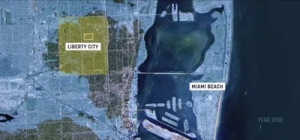
Liberty City, which sits on the Biscayne Ridge at roughly 10 to 15 feet above sea level, is significantly more elevated than coastal communities rapidly losing ground to rising seas. (IMAGE CREDIT: WLRN)
Harewood’s experience reflects a growing reality across Liberty City. Longtime homeowners say they are inundated with calls, texts, letters, and cash offers from investors who recognize what residents have long known: Liberty City’s land is becoming increasingly valuable.
One reason is geography. As one of Miami’s most historic Black communities, Liberty City sits atop the Biscayne Ridge, roughly 10 to 15 feet above sea level. That elevation has made the neighborhood particularly attractive as climate change increases flooding risks in lower-lying coastal communities.
Property Values Surge
According to Elaine Black, president and CEO of the Liberty City Community Revitalization Trust, investor interest accelerated after the housing market crash of the late 2000s.
“The downturn in the market caused more properties to go down in value,” Black said. “A lot of people came into the community and began buying properties, and that sparked real interest from outside investors.”
At the same time, redevelopment projects in nearby areas such as Midtown Miami began changing perceptions of urban neighborhoods that developers had previously overlooked.
“Property values have increased dramatically,” said Bernard Phanord, a real estate broker and president of the Collective Empowerment Group. “Prices have absolutely skyrocketed. A vacant lot that might have sold for $50,000 or $60,000 ten years ago may now sell for $250,000 or more.”
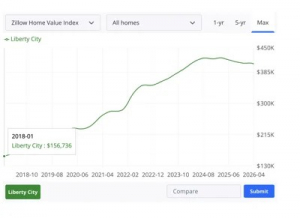
A graphic of home prices in Liberty City increasing from 2018 to 2026. A house in 2018 went for around $150,000; nowadays, the price ranges between $350,000 and $450,000. (GRAPHIC CREDIT: Zillow)
Home values throughout Liberty City now average roughly $430,000, while some areas have experienced even steeper increases. In ZIP code 33127, which overlaps with Wynwood and Little Haiti, median home prices have climbed above $660,000. New construction homes are now approaching the $1 million mark.
The neighborhood’s proximity to Wynwood, the Design District, and downtown Miami has fueled demand from investors seeking comparatively affordable land. House flipping has also become increasingly common, with investors purchasing homes, renovating them, and reselling them for hundreds of thousands of dollars more.
The ongoing redevelopment of Liberty Square has further accelerated investment. A public-private initiative exceeding $220 million has transformed portions of the neighborhood and increased market interest.
Phanord noted that Liberty City is not alone. Similar trends are occurring in Brownsville, Overtown, Miami Gardens, Opa-locka, and parts of South Dade.
“Areas that were once considered blighted or undervalued are now seeing homes selling for half a million dollars or more,” Phanord said.
Climate Gentrification Concerns
For many residents, Liberty City’s growing appeal is tied directly to its elevation.
“I never experienced a flood,” said homeowner Tara Bloom, who inherited her grandmother’s home built in the 1950s. “I can see flooding in other neighborhoods, but not here.”
Community leaders increasingly connect rising property values to what researchers call climate gentrification—the migration of investment and wealth toward higher-elevation communities perceived as less vulnerable to sea-level rise.
“This is prime real estate,” said Robert Jones, communications director for SMILE Trust. “Scientists say South Beach could eventually be underwater, so people are looking inland. This area could become the new beachfront.”
Jones said investors are often willing to pay premium prices, creating pressure on homeowners to sell.
“Once one house sells for a higher value, it encourages other owners to sell,” Jones said.
Holding On to Homeownership
For residents like Naomie and Errick Pigatt, rising property values represent both opportunity and concern. The couple purchased their four-bedroom home approximately 13 years ago through a first-time homebuyer program supported by the Liberty City Community Revitalization Trust. They paid about $130,000. Today, they estimate the property is worth nearly $580,000. Yet they continue receiving calls from investors.
“They want to lowball me into selling something for cheap because they want to make a profit,” Errick Pigatt said.
Steven Carroll, whose father, Earl J. Carroll, was Miami-Dade County’s first Black commissioner, purchased his Liberty City home in 2005 for approximately $135,000. Today, he estimates it is worth around $400,000. Recently, an investor offered him just over $200,000.
“As an investor, I understand it,” Carroll said. “But housing isn’t like a used car. This is someone’s investment and often their greatest asset.”
Residents repeatedly point to homeownership as one of the few reliable paths toward generational wealth.
“That’s the key to all of it,” Naomie Pigatt said. “Generational wealth is very important, and a lot of Black families haven’t had those opportunities.”
Still, community leaders caution that selling may not provide the financial security homeowners expect.
“If I sell my house for $500,000 but homes around me cost $675,000, where am I going to live?” Phanord asked.
Carroll echoed that concern.
“What’s keeping me here is that I can’t afford to move anywhere else,” Carrikk said. “The housing costs in Miami-Dade have become unrealistic.”
Many residents also worry about displacement.
“We’ve been pushed from one neighborhood to another throughout history,” one resident said. “Now it feels like they want to push us out again because they’ve discovered Liberty City sits 15 feet above sea level.”
Jones emphasized that residents are not opposed to neighborhood improvements.
“We’re not against gentrification,” Jones said. “We’re against not being part of the gentrification. The people who built these communities should be able to benefit from their growth.”
Preserving Community Ownership
Leaders at the Liberty City Community Revitalization Trust say they anticipated these pressures years ago. Since the mid-2000s, the organization has acquired distressed properties in an effort to keep land under community control and prevent large-scale investor ownership.
“That was critical,” Black said. “Otherwise, that land would have gone to the highest bidder.”
Today, the Trust sells homes to local residents below market value—typically between $250,000 and $300,000—while requiring resale restrictions that preserve affordability for future generations.
“The property must be resold to another low-income buyer,” Black explained.
The organization also offers workshops on estate planning, heirs’ property issues, wills, and financial literacy to help residents navigate rising property values and increasing development pressure.
Black warns that many homeowners underestimate how difficult it would be to remain in Miami after selling.
“People might find themselves in a situation where they sell their home and then realize they don’t have enough money to buy or rent elsewhere in the county,” Black said.
For advocates, the message remains straightforward.
“If you can hold on to your property—for legacy and for generational wealth—hold on,” Phanord said. “God isn’t making any more land.”
Source: The Miami Times

